
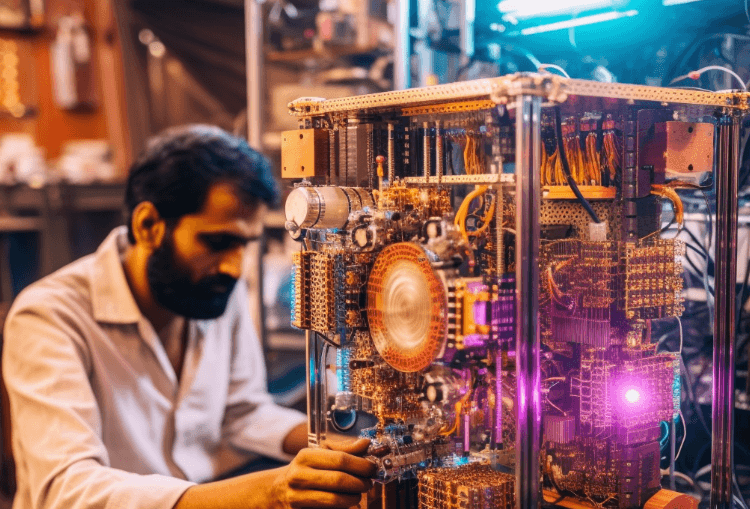
The world is on the brink of a technological revolution driven by quantum computing—a field that promises to transform industries, solve complex problems, and redefine the future of technology. In this article, we delve into quantum computing’s principles, applications, challenges, and its profound impact on society.
Understanding Quantum Computing
What is Quantum Computing?
Quantum computing is a groundbreaking approach to computation that leverages quantum mechanics—the fundamental principles governing particles at the atomic and subatomic levels. Unlike classical computers, which use binary bits (0s and 1s), quantum computers use quantum bits, or qubits, capable of existing in multiple states simultaneously.
Differences Between Classical and Quantum Computing
While classical computers process one calculation at a time, quantum computers perform many simultaneously. This makes them ideal for solving problems involving massive datasets or complex calculations, which classical systems struggle to handle efficiently.
Basic Principles of Quantum Computing
- Superposition: Qubits can exist in multiple states (0 and 1) simultaneously.
- Entanglement: Qubits become interconnected, so the state of one affects the state of another, regardless of distance.
- Quantum Gates: These manipulate qubits to perform computations, analogous to logical gates in classical computing.
History of Quantum Computing
Origins of Quantum Theory
The foundation of quantum computing lies in quantum mechanics, introduced in the early 20th century by physicists like Max Planck and Albert Einstein. Quantum theory’s application to computing was later proposed by Richard Feynman in the 1980s.
Pioneers of Quantum Computing
David Deutsch formulated the concept of a universal quantum computer, laying the groundwork for theoretical and practical advancements.
Key Milestones
In 1994, Peter Shor developed Shor’s algorithm, showing how quantum computers could break classical encryption. In 2019, Google claimed quantum supremacy with its quantum computer solving a complex problem faster than a supercomputer.
How Quantum Computers Work
Qubits and Their Role
Unlike classical bits, qubits exploit quantum properties, allowing for parallel processing of information.
Quantum Circuits and Gates
Quantum circuits perform computations through a series of quantum gates that manipulate qubits’ states.
Role of Quantum Mechanics in Computation
Quantum computers rely on phenomena like wave interference and quantum entanglement to achieve computational power beyond classical systems.
Key Advantages of Quantum Computing
- Speed and Efficiency: Solve problems like optimization and simulations exponentially faster.
- Cryptography: Revolutionize data encryption and decryption.
- AI and Machine Learning: Enhance processing power for training complex AI models.
Challenges in Quantum Computing
Despite its promise, quantum computing faces several challenges. Hardware limitations require maintaining qubits in stable states, which demands near-zero temperatures and intricate setups. Noise and interference disrupt computations, requiring advanced error-correcting techniques. Additionally, building large-scale quantum computers with thousands of qubits remains a significant hurdle.
Current State of Quantum Computing
Leading Companies
Google, IBM, and startups like Rigetti Computing are leading the charge in quantum research and development.
Notable Achievements
From quantum supremacy to breakthroughs in algorithms, progress has been steady and impactful.
Accessible Platforms
Platforms like IBM Quantum Experience allow researchers and enthusiasts to experiment with quantum computing.
Applications of Quantum Computing
Healthcare and Drug Discovery
Quantum computers simulate molecular structures, expediting drug discovery and personalized medicine.
Financial Modeling
Banks and hedge funds use quantum computing to optimize portfolios, analyze risk, and predict market trends.
Climate Modeling
Quantum systems tackle complex climate models, helping predict changes and devise sustainability strategies.
Quantum Computing in AI and Machine Learning
Quantum computing accelerates data processing, enhancing machine learning algorithms for faster and more accurate insights.
Revolutionizing Cryptography
Quantum computers pose a threat to current encryption methods, leading to the development of quantum-resistant cryptographic systems.
Breakthroughs in Material Science
Quantum simulations enable the discovery of new materials, impacting industries like energy storage and superconductivity.
Ethical and Social Implications
Quantum computing may render certain skills obsolete while creating demand for new expertise. The power of quantum technology could be exploited for malicious purposes, posing ethical challenges. Ensuring global access to quantum advancements is crucial for balanced progress.
Future Prospects of Quantum Computing
Quantum computing’s future is filled with possibilities, from a fully functional quantum internet to mainstream applications in everyday life. Integration with AI and machine learning will redefine how we interact with technology, while ethical considerations will guide its responsible use.
FAQs About Quantum Computing
What is quantum computing used for? Quantum computing excels in optimization, simulation, cryptography, and AI applications.
Will quantum computers replace classical computers? No, they will complement classical computers for specific tasks requiring immense computational power.
How secure is quantum computing? Quantum computers challenge existing encryption, but quantum-safe cryptography is emerging to address this.
When will quantum computing become mainstream? While significant progress is expected by 2030, mainstream adoption depends on overcoming technical challenges.
Can I learn quantum computing without a physics background? Yes, there are beginner-friendly resources and platforms for enthusiasts.
How do quantum computers impact AI? Quantum computers process data faster, optimizing AI and machine learning algorithms.
Conclusion
Quantum computing represents the next frontier in technology, poised to revolutionize industries and address challenges beyond the capabilities of classical systems. While hurdles remain, the progress made so far is a testament to its transformative potential. As we venture into this quantum era, staying informed and engaged will ensure that we harness its power responsibly and equitably.


